
Best Digital Freight Forwarding Tools for Ecommerce Businesses in 2026

On this page
Shipping products internationally is one of the biggest challenges for ecommerce brands. Even if you have reliable suppliers and strong sales, problems with freight delays, missing documents, customs issues, or poor shipment visibility can quickly affect customer satisfaction.
Many online store owners solve this by working with freight forwarders. However, the quality of your freight partner often depends on the technology they use behind the scenes.
Digital freight forwarding software helps logistics companies manage shipments, automate paperwork, track cargo movement, and provide better updates to their customers. For ecommerce businesses, this means fewer "Where is my order?" problems, faster problem resolution, and more confidence when scaling international sales.
In this guide, we review five digital freight forwarding platforms that ecommerce brands may encounter when choosing logistics partners. These tools are mainly built for freight forwarders, but understanding what they offer can help store owners evaluate whether a shipping provider has the systems needed to support growing order volumes.
Quick Summary: Best Digital Freight Forwarding Tools for Ecommerce Brands
Note: All data in this table is sourced from review platforms and the official websites of the listed companies, as of September 2026.
| Company Name | Years Operating | Headquartered In | Rating |
|---|---|---|---|
| Logistaas | Est. 2014 | Amman, Jordan | 4.5/5 on Capterra |
| Linbis | Est. 2013 | Miami, Florida, USA | 5.0/5 on Capterra (3 reviews) |
| Riege | Est. 1985 | Meerbusch, Germany | Industry recognized |
| Shipthis | Est. 2017 | Newark, Delaware, USA | 4.6/5 on Capterra (13 reviews) |
| Logipulse | Est. 2017 | Kerala, India | Limited public reviews |
Why Ecommerce Businesses Should Pay Attention to Freight Forwarding Software
When ecommerce brands choose a freight forwarder, the decision is usually based on shipping rates and delivery times. However, technology is becoming just as important.
A freight partner using modern software can usually provide:
- Real-time shipment updates
- Faster document processing
- Better communication between suppliers, carriers, and customers
- More accurate shipping estimates
- Easier customs coordination
Without these systems, logistics teams often rely on manual spreadsheets, email chains, and disconnected tracking systems. This makes it harder for ecommerce businesses to know where inventory is, when delays will happen, or whether customers will receive orders on time.
The right freight forwarding technology does not replace a freight forwarder. Instead, it helps the forwarder provide a more reliable service.
Top 5 Digital Freight Forwarding Tools for Ecommerce Businesses
1. Logistaas
What Does Logistaas Do?
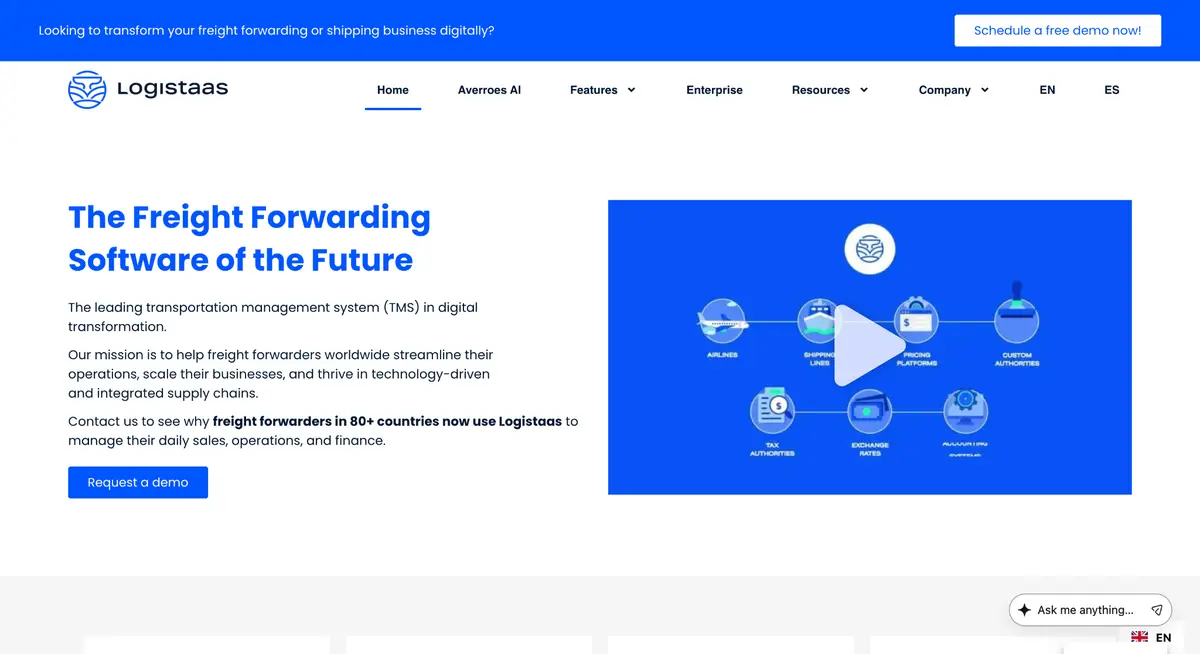
Logistaas is a transportation management system built for freight forwarders, covering air, sea, land, and customs operations within a single platform. What separates it from general logistics tools is the native accounting module, which handles digital invoicing in more than 30 countries without requiring external software. Freight forwarders in more than 80 countries use Logistaas, and the platform connects to 60+ ocean carriers through its INTTRA integration, built directly into the platform, not added on afterward.
Why Does Logistaas Stand Out?
Logistaas solves one of the most persistent problems in freight forwarding: the need to run separate systems for CRM, operations, finance, and accounting, which constantly creates data gaps and reconciliation headaches. Their unified approach means forwarders managing complex consolidations, multi-branch networks, or diverse trade lanes don't have to stitch together workarounds just to close the books at month end.
Summary of Real User Reviews
Logistaas holds a 4.5 out of 5 on Capterra across roughly 30 reviews, with ease of use scoring 4.6 and features scoring 4.4. Users call out consolidation management and multi-mode handling as strengths. The main friction points are around historical document search and limited report customization on standard plans, though the overall sentiment is clearly positive for forwarders running international operations.
2. Linbis
What Does Linbis Do?
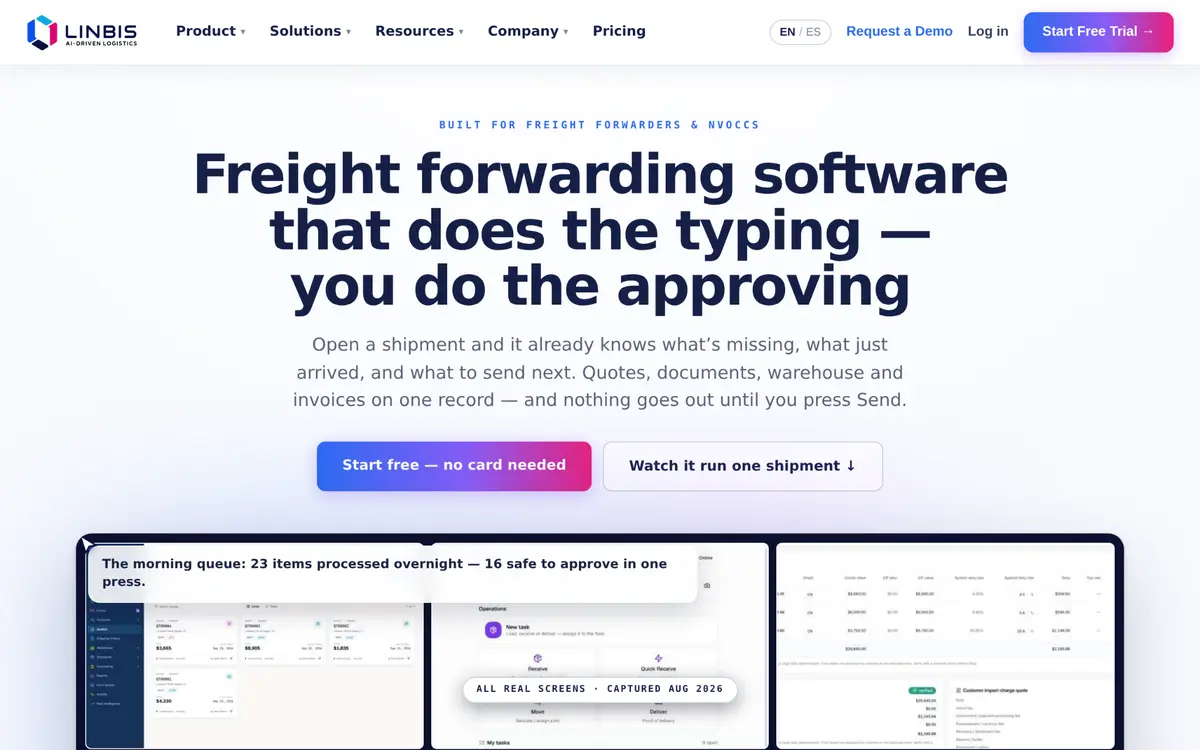
Linbis is a logistics software platform that covers freight forwarding, warehouse management, and 3PL operations in one place. It supports air, ocean, and ground freight with modules for quotation, dispatch, shipment tracking, and document creation. What makes it worth a look is the AI layer built into document handling, which cuts down on manual data entry errors that typically slow down customs clearance. Real-time analytics and performance dashboards give operations teams actual visibility into carrier metrics rather than end-of-day reports.
Why Does Linbis Stand Out?
Linbis addresses the challenge of managing freight and warehouse operations from two separate systems, which creates inventory blind spots and coordination delays that cost forwarders time and money. Combining AI-driven document creation with live analytics puts both operational accuracy and forward planning in the same interface, which is genuinely useful for 3PLs managing multiple client accounts.
Summary of Real User Reviews
Public review data for Linbis is limited at this stage: its 5.0 rating on Capterra comes from only three reviews, which makes it harder to assess real-world sentiment in depth. That said, the platform's feature set, particularly around AI-assisted documentation and warehouse management system connectivity, reflects a clear focus on reducing the manual workload that freight teams deal with daily. The lack of a larger review pool is something worth watching as they grow.
3. Riege
What Does Riege Do?
Riege Software has been building freight forwarding technology since 1985, and their flagship product, Scope, is a TMS covering air freight, ocean freight, and customs processes. They serve more than 900 customers and 16,000 users across 60+ countries through seven global branches. The platform includes real-time tracking, automated customs data exchange across multiple countries, and emissions calculation, which is increasingly relevant for forwarders dealing with compliance reporting requirements alongside standard compliance needs.
Why Does Riege Stand Out?
Riege addresses the challenge of running multi-country customs operations from a single system, a problem that trips up plenty of platforms that are strong domestically but fragile at the international edges. Nearly four decades of freight-specific development means the edge cases are already accounted for, which translates into fewer surprises during peak shipment volumes.
Summary of Real User Reviews
Riege earned "Most Valuable Industry Partner" recognition at the 5 Star Logistics Network conference in Bangkok, which signals strong standing within the forwarding community. With 900+ customers across 60+ countries, the trust at the enterprise level is well established. For forwarders who want a platform backed by decades of actual freight experience, Riege's tenure carries real weight.
4. Shipthis
What Does Shipthis Do?
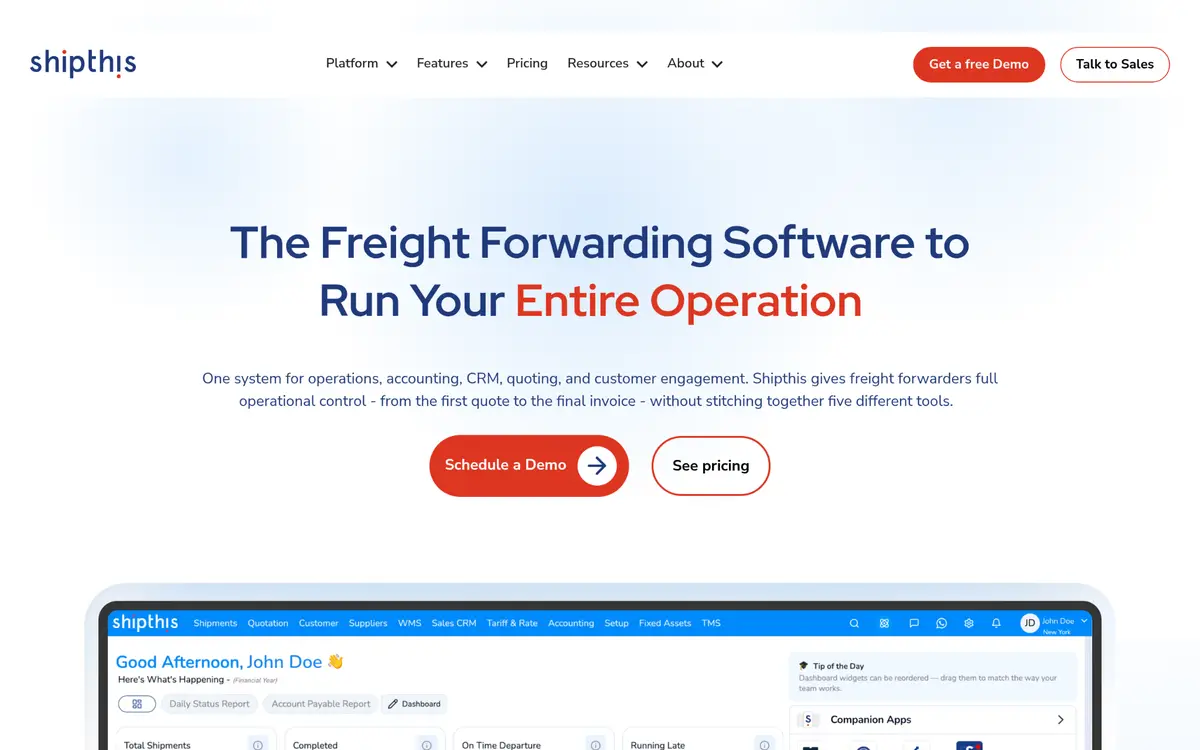
Shipthis is an AI-native freight ERP built for freight forwarders, logistics companies, and NVOCCs that need end-to-end digital management across air, sea, road, and rail. The platform covers shipment management, CRM, quotation, tariff and rate management, warehouse management, and vendor portals, with AI handling document intelligence, email parsing, and automated pricing. The accounting module is GAAP-compliant and tracks real-time profit and loss per shipment, which is genuinely useful for forwarders who want financial clarity at the job level rather than waiting for month-end rollups. Pricing is $89 per user per month with all modules included, plus a 30-day free trial (per-user pricing keeps it accessible for smaller operators, but the cost grows with team size).
Why Does Shipthis Stand Out?
Shipthis tackles the operational burden of email-heavy freight workflows, where teams manually read, sort, and enter booking requests that AI can now parse and route automatically. That kind of time saving at the front end of a shipment lifecycle adds up quickly across hundreds of jobs per month.
Summary of Real User Reviews
Shipthis holds a 4.6 out of 5 on Capterra, but from only 13 reviews, with a single review on G2, so user sentiment is still hard to verify at scale. The all-inclusive pricing model and AI-native setup suggest it's built for forwarders who want modern tooling without the burden of stitching together multiple systems. The real-time P&L per shipment is a standout feature that operations-focused teams would find genuinely useful.
5. Logipulse
What Does Logipulse Do?
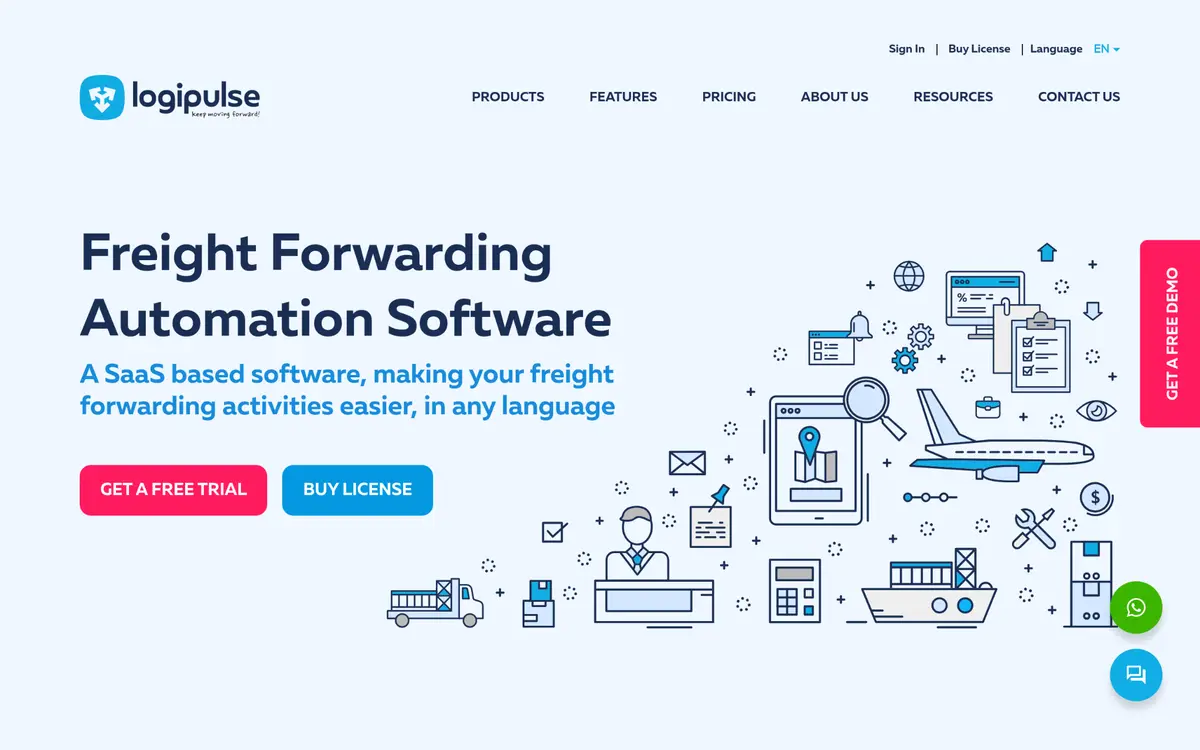
Logipulse is a SaaS logistics management platform developed by Stellosys, designed for freight forwarders, customs brokers, and 3PLs. The platform covers land, sea, and air import and export management, customs clearance, warehouse management, transport management, and accounting, all within a single subscription. Multi-device accessibility across desktop, tablet, mobile, and scanning devices makes it practical for teams spread across different locations. Pricing is modular (Silver, Gold, and Diamond tiers, with a custom package for enterprises), so teams pick and pay only for the modules they need, which positions it as a real alternative to enterprise platforms for operators who don't need that level of overhead (or cost).
Why Does Logipulse Stand Out?
Logipulse fills the gap for smaller freight forwarders who need a full-featured platform but can't justify the pricing or setup weight of enterprise options like CargoWise or Magaya. The multi-device support and multilingual capabilities make it particularly practical for operators running lean teams across multiple regions.
Summary of Real User Reviews
Standalone public reviews for Logipulse are limited, so direct feedback from customers is harder to assess independently. The platform's affordability and broad feature set make it a strong candidate for smaller operators who want a step up from manual processes without the enterprise price tag. The pay-for-what-you-use pricing model is a practical differentiator for budget-conscious forwarders evaluating their first real TMS.
How Ecommerce Store Owners Should Evaluate a Freight Forwarder's Technology
Choosing a freight forwarder is not only about getting the lowest shipping quote. The technology behind your logistics partner affects how easily you can scale.
Before selecting a freight forwarder, ask:
1. Can I Track Shipments Easily?
Your freight partner should provide:
- Shipment status updates
- Estimated arrival dates
- Exception notifications
- Document access
A good system reduces the need for constant email follow-ups.
2. Does the Forwarder Handle Documentation Digitally?
International shipping involves:
- Commercial invoices
- Bills of lading
- Customs documents
- Import paperwork
Digital document management reduces errors and speeds up problem solving. It also makes it easier to calculate your landed cost accurately, since duties and fees are documented in one place.
3. Can They Support Your Growth?
A freight partner that works for 50 shipments per month may struggle at 500 shipments per month.
Look for providers with systems that support:
- Multiple suppliers
- Multiple countries
- Different shipping methods
- Growing order volume
4. Do They Provide Transparent Communication?
Technology should make communication easier, not hide information.
Ask whether your freight forwarder provides:
- Customer portals
- Automated updates
- Online quotations
- Shipment dashboards
Final Thoughts
For ecommerce businesses, digital freight forwarding tools are not something you necessarily buy. They are something you should look for when choosing logistics partners.
The best freight forwarder is not always the cheapest option. A provider with better systems can save time through clearer communication, fewer documentation problems, and better shipment visibility.
For smaller brands, platforms like Shipthis, Linbis, or Logipulse may indicate a technology-focused logistics provider. Larger ecommerce companies shipping internationally may benefit from freight partners using enterprise platforms like Riege Scope or Logistaas.
The goal is simple: choose a freight partner that gives you confidence that your inventory is moving, your documents are correct, and your customers will receive orders on time.
References
- Logistaas, official website: logistaas.com
- Capterra, Logistaas reviews and pricing: Logistaas on Capterra
- Capterra, Logistaas reviews and ratings: Logistaas customer reviews
- Software Advice, Logistaas pricing and product information: Logistaas on Software Advice
- Linbis, official pricing information: Linbis pricing
- Riege Software, Scope product information: Scope freight forwarding software by Riege
- Riege Software, company information: About Riege Software
- Shipthis, official pricing information: Shipthis pricing
- Capterra, Shipthis reviews and ratings: Shipthis customer reviews
- G2, Shipthis customer reviews: Shipthis reviews on G2
- Logipulse, official product and pricing information: Logipulse product information and Logipulse pricing
- Capterra, Logipulse reviews and ratings: Logipulse on Capterra
Frequently Asked Questions
Do ecommerce businesses need freight forwarding software?
Usually, ecommerce stores do not need to purchase freight forwarding software themselves. These platforms are mainly used by logistics companies. However, understanding the tools your freight partner uses can help you choose a provider with better visibility and communication.
Can I use these tools without being a freight forwarder?
Most digital freight forwarding platforms are designed for logistics companies rather than ecommerce merchants. Store owners usually interact through customer portals, tracking systems, or integrations provided by their freight partner.
Does freight forwarding software reduce shipping delays?
Software cannot prevent every delay caused by weather, customs inspections, or carrier issues. However, better systems can help identify problems earlier by improving tracking, documentation, and communication.
What should I ask a freight forwarder before hiring them?
Ask how they provide shipment updates, whether you can access documents online, whether they support your shipping routes, how they handle customs issues, and what technology they use to manage shipments.