
How to Dropship From DHgate to Shopify (2026 Guide)

On this page
If you want to dropship from DHgate to Shopify, the short version is this: list a DHgate product in your Shopify store, set your own price, and place the DHgate order yourself after a customer buys, because DHgate has no official Shopify app and no hands-off automation. DHgate can be a genuinely cheap, deep catalog for sourcing, but it is import-only, fulfillment is manual, and the 2026 import-duty changes have quietly reset the margin math that older guides still ignore.
DHgate is not new, but it had a moment. In April 2025 it climbed into the top three of the US App Store as creators promoted China-factory products during the tariff news cycle (TechCrunch, April 2025). That attention is real, and so is the opportunity. This guide walks the full workflow, shows where DHgate breaks, and is honest about the parts most articles skip: counterfeits, shipping time, minimum order quantities, manual fulfillment, and the new duties you now have to price in.
Is DHgate legit and safe for dropshipping in 2026?
DHgate is a legitimate, long-running marketplace, but "safe for dropshipping" depends entirely on which seller you choose and what you sell. DHgate launched in 2004 as a cross-border wholesale and retail platform connecting global buyers with mostly China-based sellers, and it offers buyer protection that holds your payment until you confirm the order arrived. The platform is real. The risk is not the platform, it is seller quality and product type.
Two cautions matter more than anything else. First, quality varies by seller, because DHgate is a marketplace of millions of independent sellers, not a single vetted catalog. Filter for sellers with high positive feedback, a long transaction history, and verified badges, and order a sample before you list anything. Second, DHgate hosts a large volume of branded "dupes" and outright counterfeits. Reselling branded replicas is illegal and exposes you to chargebacks and store termination, a risk the 2025 viral wave amplified when shoppers flooded DHgate looking for luxury dupes (Fortune, April 2025). Source generic, unbranded products only. Do that, and DHgate is as safe as any China-based sourcing route. Ignore it, and no workflow will save the store.
What is DHgate, and who is it for?
DHgate is a cross-border marketplace where you buy from China-based sellers at near-wholesale prices, which makes it a sourcing option rather than a managed dropshipping service. It is best for sellers who want low product costs and a wide catalog, and who are willing to vet suppliers and handle fulfillment manually. It is a poor fit for anyone who needs fast, hands-off, automated order processing on day one.
The thing to understand is DHgate's wholesale DNA. It started as a business-to-business platform, so many listings still carry a minimum order quantity (MOQ). That is fine if you stock inventory, but it is friction for single-unit dropshipping, where you buy one item per customer order. You can work around it by filtering for sellers who allow one-piece orders, but you have to look for them. DHgate is for the sourcing-minded seller, not the set-and-forget one.
How to dropship from DHgate to Shopify, step by step
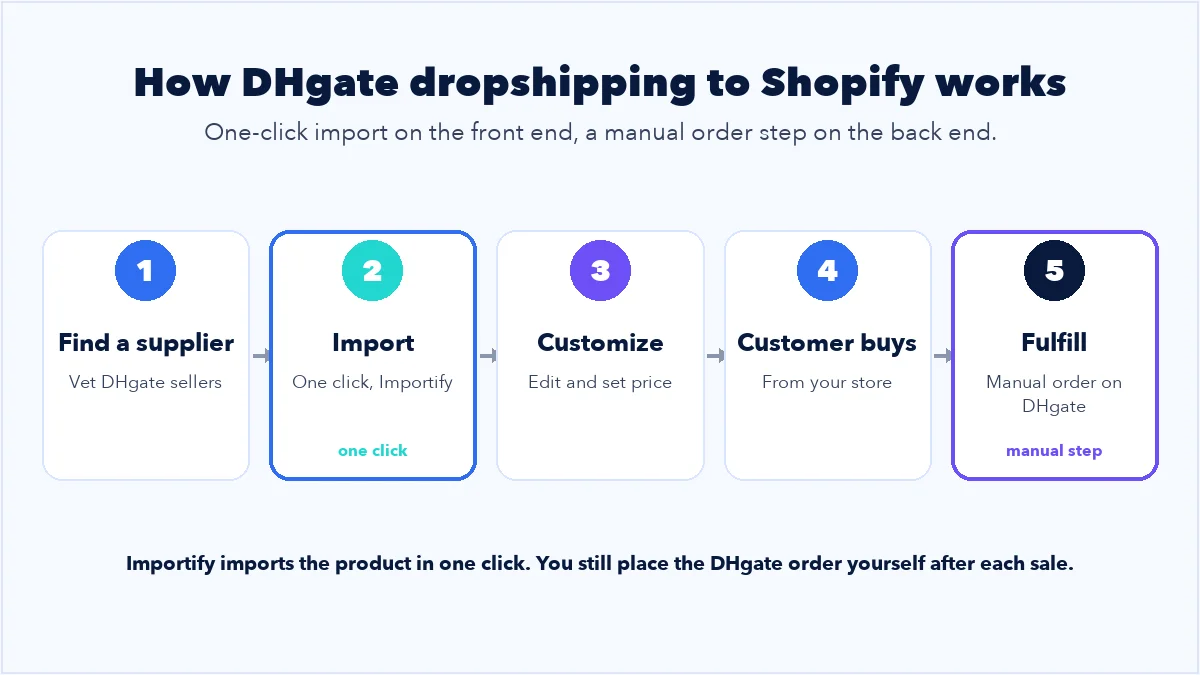
To dropship from DHgate to Shopify, you connect the two with a product importer (DHgate has no official Shopify app), import and edit the listing in your store, then place each DHgate order manually after a sale. Here is the full workflow.
- Set up your Shopify store. Pick a niche, install a clean theme, and add core pages (shipping policy, returns, contact). Your store is the brand customers trust, so it should not look like a marketplace.
- Find reliable DHgate suppliers. Search your product, then filter hard: high seller feedback, large transaction count, recent reviews with photos, and a clear willingness to ship single units. Message the seller to confirm stock, processing time, and whether they offer a local or overseas warehouse option for faster delivery.
- Connect DHgate to Shopify with an importer. Because there is no native DHgate app, you use a tool like Importify to pull the product in. With the browser extension on the DHgate product page, one click imports the title, images, variants, and pricing into your store as a draft.
- Customize and price the product. Rewrite the title and description (raw DHgate copy hurts conversion and SEO), trim junk variants, and set your margin. Do not just apply a flat 2x to 3x markup, because that breaks on mid-priced items. Use cost-based pricing rules so a $6 item and a $40 item get different logic.
- Publish and get orders. Drive traffic through ads, content, SEO, email, or social. Your customer buys from your store at your price.
- Fulfill the order manually. After a sale, you place the matching order on DHgate, enter your customer's shipping address, and pay the supplier. When it ships, you add the tracking number in Shopify. This step is manual on DHgate, which is the single biggest operational difference from a fully automated AliExpress flow.
Benefits and real risks of DHgate dropshipping
DHgate's benefit is low cost and catalog depth; its risk is that the post-purchase experience, the part customers judge you on, is outside your control. The table below is the honest trade-off, factor by factor.
| Factor | Benefit | Risk to watch |
|---|---|---|
| Price | Near-wholesale costs leave room for margin | 2026 import duties and shipping can erase a thin margin (see below) |
| Catalog | Huge range across electronics, fashion, jewelry, home | Branded "dupes" and counterfeits are common and illegal to resell |
| Suppliers | Direct access to many China-based sellers | Quality is per-seller, not platform-guaranteed; vet and sample first |
| Order size | Some sellers accept single-unit orders | Many listings still enforce a minimum order quantity |
| Shipping | Express and some local-warehouse options exist | Economy shipping often runs two to six weeks |
The biggest risk is not price or shipping, it is intellectual property. DHgate's catalog includes a lot of replica and counterfeit product, and the 2025 attention pulled even more of it into view (TechCrunch, April 2025). Selling branded fakes is not a gray area. It invites takedowns, payment-processor bans, and legal exposure. Build your store on generic, unbranded products and this risk drops to near zero. For a broader view of how DHgate compares to other sourcing routes, see Best Dropshipping Suppliers in 2026.
DHgate vs AliExpress for dropshipping
Use DHgate when you want the lowest near-wholesale price and you are willing to vet sellers and fulfill manually; use AliExpress when you want single-unit orders, a smoother dropshipping flow, and the option of automated fulfillment. They overlap, but they are not the same tool.
| Question | DHgate | AliExpress |
|---|---|---|
| Pricing model | Wholesale-leaning, often cheaper at volume | Retail-leaning, built for single units |
| Minimum order | MOQ common on many listings | Single units are the norm |
| Order automation | Manual only | Can be fully automated with the right tool |
| Best for | Cost-focused sellers who vet suppliers | Fast testing and hands-off fulfillment |
If you are weighing supplier routes more broadly, two comparisons go deeper: Alibaba vs AliExpress in 2026 and CJdropshipping vs AliExpress in 2026. The pattern is consistent: pick the supplier whose price, shipping, and order rules match the stage your store is in.
The 2026 duty reality every DHgate dropshipper must model
This is the part older DHgate guides get wrong: low-value China parcels are no longer duty-free, so you must price import duties into your landed cost. The United States ended its de minimis exemption for all countries effective August 29, 2025, which means sub-$800 imports that used to clear duty-free now owe duties and must be formally entered with customs (EY, August 2025). The old "ship cheap parcels under $800 with no duty" model is gone.
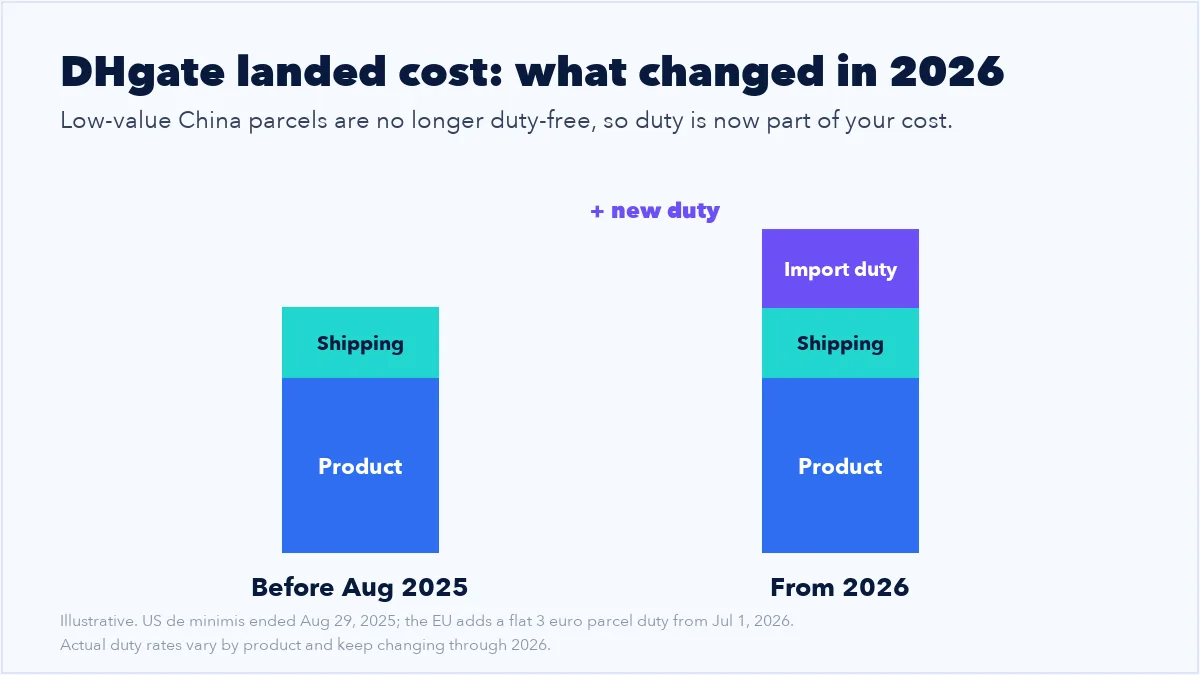
It also keeps moving, so date-stamp what you rely on. The exact duty rates on low-value imports are still being adjusted through 2026, so confirm the current rate before you price rather than trusting a number from an older guide. Selling into the EU adds another change: the EU abolishes its 150 euro duty-free threshold and applies a flat 3 euro customs duty per parcel from July 1, 2026 (Avalara, November 2025).
The practical takeaway is simple. Your landed cost is now product cost plus shipping plus duty, and your price has to clear all three and still leave margin. Prefer faster express or local-warehouse listings where you can, keep your catalog generic so duty rates are predictable, and recheck the live duty position each quarter because the 2026 rules are still in flux.
How Importify handles DHgate import
Importify connects DHgate to your store by importing products in one click, then lets you edit and price them before publishing, with the honest limit that DHgate order fulfillment stays manual. Because DHgate has no official Shopify app, an importer is how you bridge the gap, and Importify supports DHgate as one of its 25+ supported marketplaces across Shopify, Wix, WooCommerce, BigCommerce, and Jumpseller (Importify DHgate importer).
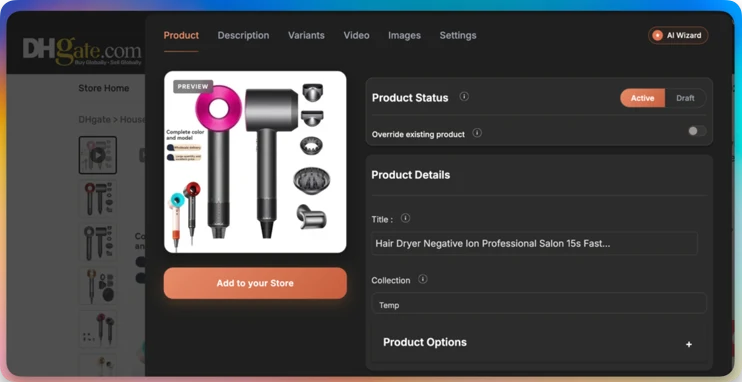
Three features do the heavy lifting. One-Click Import brings the DHgate title, images, variants, and pricing into a draft so you are not copying fields by hand. Product Customization lets you rewrite the title and description, trim or split variants, and clean up the listing before it goes live, which matters because raw DHgate copy converts poorly. Smart Pricing Rules apply fixed or percentage margins, rounding, and cost-range rules, so you can build the new 2026 duty and shipping reality into your price automatically instead of guessing. On Premium and Gold, the AI Product Optimizer runs on Importify's own OpenAI account, so you do not need an OpenAI API key to rewrite titles and descriptions into cleaner, store-ready copy.
Be clear-eyed about the one limit. Importify imports from DHgate, but it does not auto-place DHgate orders. Full automated order fulfillment is available only for AliExpress on the Gold plan. For DHgate, you place each order yourself and mark it fulfilled. That is the same manual reality every DHgate route shares, so the win is in the import and listing speed, not in hands-off ordering.
How to get started with DHgate dropshipping
To get started, set up your store, pick a few generic products from well-rated DHgate sellers, import and price them with the duty math built in, and run a small test before you scale. A short, concrete path:
- Launch a clean Shopify store with real policy pages and a niche focus.
- Shortlist three to five vetted DHgate sellers with high feedback, single-unit orders, and reasonable shipping.
- Order one sample per product so you see real quality and delivery time before a customer does.
- Import with Importify and rewrite each listing, then set prices using cost-range rules that include shipping and duty.
- Test with a small ad or content push, fulfill the first orders manually, and track delivery time and refund rate.
- Keep winners, drop the rest, and only then think about scaling volume.
If you want the import side handled cleanly from the start, you can import from DHgate with Importify and spend your time on supplier vetting and marketing instead of manual data entry.
Conclusion
DHgate can work for dropshipping if you respect three things. Choose sellers carefully and sell only generic, unbranded products, because counterfeits are the fastest way to lose a store. Accept that fulfillment is manual, so build for it rather than expecting automation DHgate does not offer. And model the 2026 duties into your landed cost, because the duty-free era that older guides assume is over. Get those right, use an importer to remove the busywork, and DHgate becomes a low-cost sourcing option rather than a gamble.
References
- EY, US suspends duty-free de minimis treatment for low-value shipments (August 2025)
- Avalara, EU to end the 150 euro customs-duty exemption in 2026 (November 2025)
- TechCrunch, Chinese marketplace DHgate becomes a top US app (April 2025)
- Fortune, DHgate atop the App Store as shoppers seek Chinese replicas (April 2025)
Frequently Asked Questions
How do you dropship from DHgate to Shopify?
You list a DHgate product in your Shopify store using an importer (DHgate has no official Shopify app), set your own price, and then place the DHgate order yourself after a customer buys, entering their shipping address. Tools like Importify import the title, images, and variants in one click, but the order step stays manual.
Is DHgate safe and legit for dropshipping in 2026?
DHgate is a legitimate marketplace that holds payments in escrow, but safety depends on the seller and the product. Choose sellers with high feedback and a long transaction history, order samples first, and sell only generic, unbranded products. Reselling branded replicas is illegal and risks chargebacks and store termination.
How long does DHgate shipping take to the US?
Economy and standard shipping from DHgate often takes two to six weeks, while express options like DHL, FedEx, or UPS can arrive in roughly one week. Some sellers offer local or overseas warehouse fulfillment that ships faster. Set customer expectations honestly and prefer faster options where margin allows.
Does DHgate have an official Shopify app?
No. DHgate does not offer an official Shopify app, so you connect the two with a third-party product importer. Importify is one option that supports DHgate, importing products into Shopify, Wix, WooCommerce, BigCommerce, or Jumpseller.
Do you have to pay import duties on DHgate orders now?
Yes, in many cases. The United States ended its de minimis exemption for all countries on August 29, 2025, so low-value China parcels that were duty-free under $800 now owe duties. The EU adds a flat 3 euro customs duty per parcel from July 1, 2026. Always price duties into your landed cost and confirm current rates, which are still changing in 2026.
Is DHgate cheaper than AliExpress for dropshipping?
DHgate is often cheaper at near-wholesale prices, especially when a seller offers volume or single-unit deals, but AliExpress is built for single-unit dropshipping and supports automated fulfillment that DHgate does not. Choose DHgate for cost when you can vet suppliers, and AliExpress for a smoother, more automated flow.